Sign-ins by provider
Join each user to their identities and sessions.
select u.email, i.provider, s.created_at
from users u
join identities i on i.user_id = u.id
join sessions s on s.user_id = u.id
order by s.created_at desc
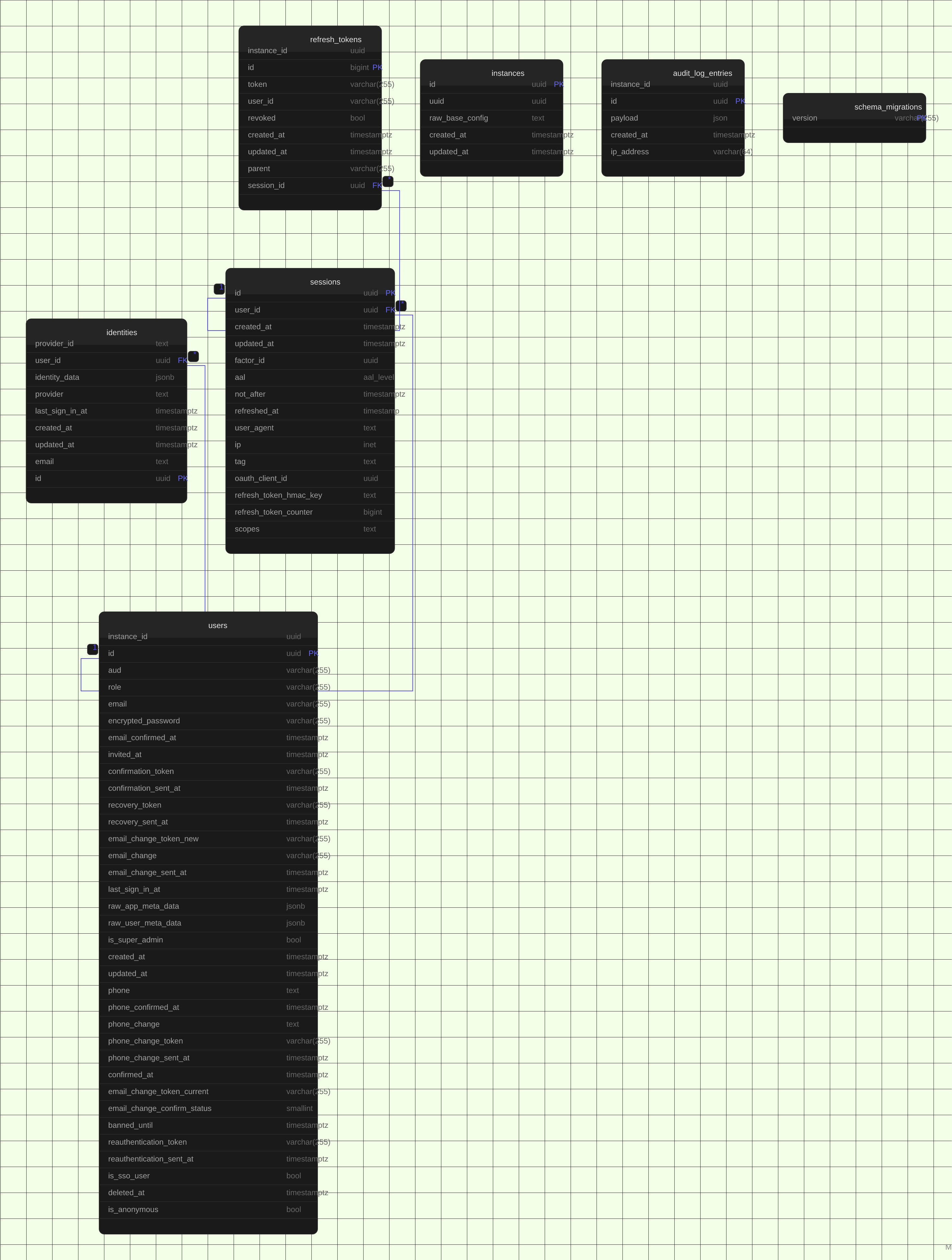
limit 50;Every Supabase project ships with a built-in auth schema managed by GoTrue. This diagram maps the auth tables - auth.users, auth.identities, auth.sessions, and refresh_tokens - with the primary keys and foreign keys between them. It documents the built-in auth schema, not your app's public tables. To diagram your own Supabase project, connect it with the Supabase ER diagram tool.
Written by Varun Krishnan · Founder, dbdiagramr
Published · Updated
Source: Supabase auth migrations v2.197.0 (supabase/auth) · License: Apache-2.0
Core auth tables from Supabase Auth (GoTrue) v2.197.0, released 2026-09-09.
Omitted here: MFA, SSO/SAML, OAuth, WebAuthn, and SCIM tables (20 optional tables in the full schema). source migrations.
This page documents Supabase's built-in auth schema, not your app's public tables. To diagram your own Supabase project and see Row Level Security status, use the Supabase ER diagram tool.
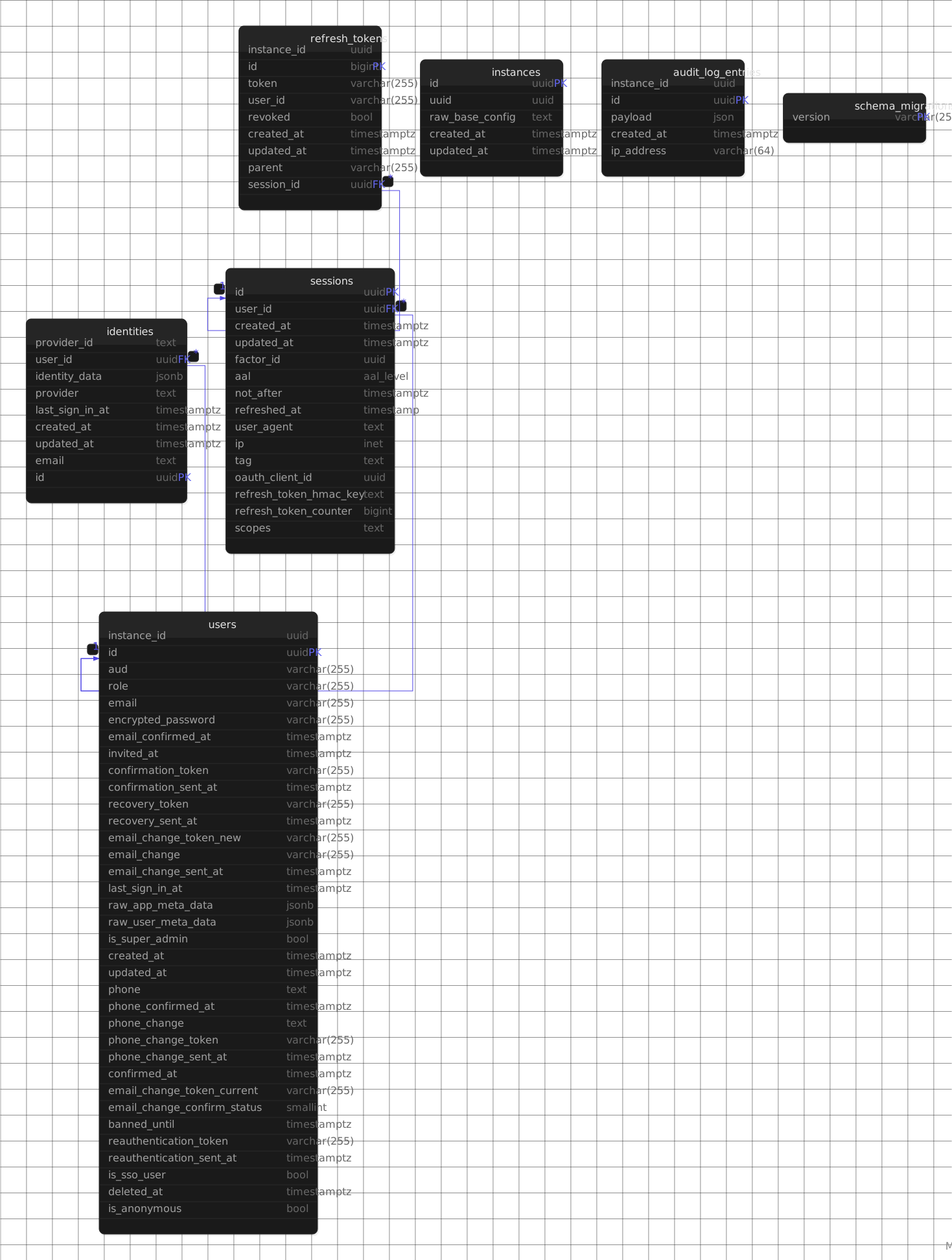
Scroll horizontally to see the full diagram. Click it to open at full size.
Paste this HTML into a README, docs page, or blog post. The image links back to the full schema page.
<a href="https://www.dbdiagramr.space/schema/supabase">
  <img src="https://www.dbdiagramr.space/schemas/supabase-er-diagram.svg" alt="Supabase Auth Schema Diagram: Users, Identities, Sessions" width="1469" height="1944" />
</a>
<p><a href="https://www.dbdiagramr.space/schema/supabase">Supabase Auth Schema Diagram: Users, Identities, Sessions</a> by dbdiagramr</p>| Column | Type | Nullable | Key |
|---|---|---|---|
| users | |||
| instance_id | uuid | Yes | - |
| id | uuid | No | PK |
| aud | varchar(255) | Yes | - |
| role | varchar(255) | Yes | - |
| varchar(255) | Yes | - | |
| encrypted_password | varchar(255) | Yes | - |
| email_confirmed_at | timestamptz | Yes | - |
| invited_at | timestamptz | Yes | - |
| confirmation_token | varchar(255) | Yes | - |
| confirmation_sent_at | timestamptz | Yes | - |
| recovery_token | varchar(255) | Yes | - |
| recovery_sent_at | timestamptz | Yes | - |
| email_change_token_new | varchar(255) | Yes | - |
| email_change | varchar(255) | Yes | - |
| email_change_sent_at | timestamptz | Yes | - |
| last_sign_in_at | timestamptz | Yes | - |
| raw_app_meta_data | jsonb | Yes | - |
| raw_user_meta_data | jsonb | Yes | - |
| is_super_admin | bool | Yes | - |
| created_at | timestamptz | Yes | - |
| updated_at | timestamptz | Yes | - |
| phone | text | Yes | - |
| phone_confirmed_at | timestamptz | Yes | - |
| phone_change | text | Yes | - |
| phone_change_token | varchar(255) | Yes | - |
| phone_change_sent_at | timestamptz | Yes | - |
| confirmed_at | timestamptz | Yes | - |
| email_change_token_current | varchar(255) | Yes | - |
| email_change_confirm_status | smallint | Yes | - |
| banned_until | timestamptz | Yes | - |
| reauthentication_token | varchar(255) | Yes | - |
| reauthentication_sent_at | timestamptz | Yes | - |
| is_sso_user | bool | No | - |
| deleted_at | timestamptz | Yes | - |
| is_anonymous | bool | No | - |
| identities | |||
| provider_id | text | No | - |
| user_id | uuid | No | FK → users.id |
| identity_data | jsonb | No | - |
| provider | text | No | - |
| last_sign_in_at | timestamptz | Yes | - |
| created_at | timestamptz | Yes | - |
| updated_at | timestamptz | Yes | - |
| text | Yes | - | |
| id | uuid | No | PK |
| sessions | |||
| id | uuid | No | PK |
| user_id | uuid | No | FK → users.id |
| created_at | timestamptz | Yes | - |
| updated_at | timestamptz | Yes | - |
| factor_id | uuid | Yes | - |
| aal | aal_level | Yes | - |
| not_after | timestamptz | Yes | - |
| refreshed_at | timestamp | Yes | - |
| user_agent | text | Yes | - |
| ip | inet | Yes | - |
| tag | text | Yes | - |
| oauth_client_id | uuid | Yes | - |
| refresh_token_hmac_key | text | Yes | - |
| refresh_token_counter | bigint | Yes | - |
| scopes | text | Yes | - |
| refresh_tokens | |||
| instance_id | uuid | Yes | - |
| id | bigint | No | PK |
| token | varchar(255) | Yes | - |
| user_id | varchar(255) | Yes | - |
| revoked | bool | Yes | - |
| created_at | timestamptz | Yes | - |
| updated_at | timestamptz | Yes | - |
| parent | varchar(255) | Yes | - |
| session_id | uuid | Yes | FK → sessions.id |
| instances | |||
| id | uuid | No | PK |
| uuid | uuid | Yes | - |
| raw_base_config | text | Yes | - |
| created_at | timestamptz | Yes | - |
| updated_at | timestamptz | Yes | - |
| audit_log_entries | |||
| instance_id | uuid | Yes | - |
| id | uuid | No | PK |
| payload | json | Yes | - |
| created_at | timestamptz | Yes | - |
| ip_address | varchar(64) | No | - |
| schema_migrations | |||
| version | varchar(255) | No | PK |
3 relationships connect the tables in this schema. Each entry shows the child columns, the parent columns they reference, and the cardinality.
sessions.oauth_client_id references auth.oauth_clients. That table is part of the optional OAuth group, so the column is shown here without a foreign-key line.
identities.user_id → users.id
One user can have many identities (identities.user_id -> users.id, required).
sessions.user_id → users.id
One user can have many sessions (sessions.user_id -> users.id, required).
refresh_tokens.session_id → sessions.id
One session can have many refresh tokens (refresh_tokens.session_id -> sessions.id, optional).
| Relationship | Type | Meaning |
|---|---|---|
| identities.user_id → users.id | One-to-many | One user can have many identities (identities.user_id -> users.id, required). |
| sessions.user_id → users.id | One-to-many | One user can have many sessions (sessions.user_id -> users.id, required). |
| refresh_tokens.session_id → sessions.id | One-to-many | One session can have many refresh tokens (refresh_tokens.session_id -> sessions.id, optional). |
These PostgreSQL queries run against the schema shown on this page.
Join each user to their identities and sessions.
select u.email, i.provider, s.created_at
from users u
join identities i on i.user_id = u.id
join sessions s on s.user_id = u.id
order by s.created_at desc
limit 50;List sessions that have not passed their not_after cutoff.
select s.id, u.email, s.aal, s.oauth_client_id, s.scopes
from sessions s
join users u on u.id = s.user_id
where s.not_after is null or s.not_after > now()
order by s.created_at desc;Trace each refresh token to its session and parent token.
select rt.id, rt.session_id, s.user_id, rt.parent, rt.revoked
from refresh_tokens rt
left join sessions s on s.id = rt.session_id
order by rt.id desc
limit 100;Find auth users that have no sign-in method linked.
select u.id, u.email
from users u
left join identities i on i.user_id = u.id
where i.id is null;The Supabase CLI dump is the quickest way to export your app schema:
supabase db dump --db-url "$SUPABASE_SESSION_POOLER_URL" -f supabase/schema.sqlThe CLI filters Supabase-managed schemas, including auth and storage, so the file above will not contain the auth tables on this page. Dump auth separately with pg_dump:
pg_dump "$SUPABASE_SESSION_POOLER_URL" --schema-only --schema=auth --no-owner --no-privileges -f auth-schema.sqlUse the session pooler connection string on port 5432 for these commands. Use a pg_dump version at least as new as the PostgreSQL server version: newer pg_dump releases can dump older servers, but older ones cannot dump newer servers. See the Supabase CLI db dump reference and the PostgreSQL pg_dump documentation.
These tables are written by Supabase Auth, not by your migrations. The main events look like this:
| Event | What changes |
|---|---|
| Sign-up | A row is created in auth.users. If email confirmations are enabled, the user must confirm the email before signing in (password auth docs). |
| Identity link | Each sign-in method gets a row in auth.identities, linked by user_id (identities docs). |
| Sign-in | A row is created in auth.sessions. The access token carries a session_id claim matching the session primary key (sessions docs). |
| Token refresh | Refresh tokens are one-time use. Reuse outside the documented grace cases terminates the session and revokes all refresh tokens for it (sessions docs). |
| Sign-out | global (the JavaScript default) ends all sessions; local ends the current session; others ends all but the current one. Affected sessions are removed and their refresh tokens are destroyed. Access tokens stay valid until they expire (sign-out docs). |
Supabase does not document the exact row-level timing for every internal write, including changes to auth.refresh_tokens. Treat those rows as managed state rather than an application event log.
The common query is "who is this user, through which provider, and on which sessions":
select u.email, i.provider, s.id as session_id
from auth.users u
join auth.identities i on i.user_id = u.id
join auth.sessions s on s.user_id = u.id
where u.id = $1;
auth.identities.user_id and auth.sessions.user_id both point at auth.users.id. Your public profile table should use the same UUID, for example public.profiles.user_id references auth.users(id), so a profile joins directly to the auth user. A normal user has at least one identity; sessions are per sign-in and can be many.
auth as read-only. Create users, identities, and sessions through the Supabase client or Admin API, not with direct inserts.auth.uid() in RLS policies. It returns the current user's UUID, which is the value your public tables should reference.--schema-only when the dump is for documentation or review.Paste your PostgreSQL connection string and get an interactive ER diagram of your own schema in under 10 seconds. No signup required.
Try it free →